Phishing Resistant MFA
Securetron Trust Platform
Phishing Resistant
MFA
Quick Overview
Traditional MFA methods such as SMS codes, email-based OTPs, and push notifications are becoming less effective against today’s attackers. Sophisticated phishing campaigns have demonstrated that second factors can be intercepted or spoofed. Attackers now exploit social engineering, man-in-the-middle tactics, and user fatigue (e.g., MFA bombing) to bypass these mechanisms. These risks are amplified in distributed, cloud-first organizations with hybrid workforces and varied device ecosystems.
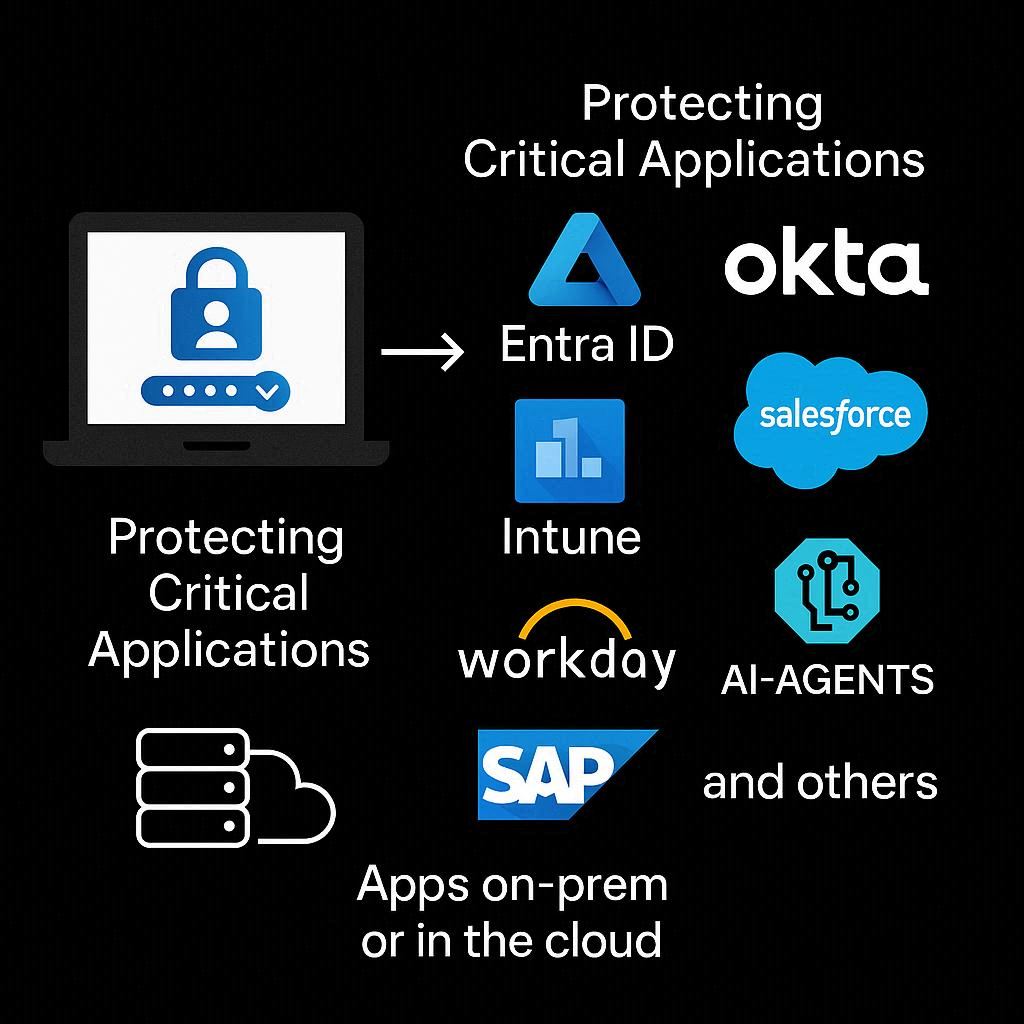
Highest Level of Assurance
🚀 Advantages
-
01
Strong assurance of user identity
-
02
Eliminates password‑based attacks
-
03
High compliance alignment (NIST, FedRAMP, etc.)
-
04
Enforces device trust
-
05
Supports Zero Trust architectures
🛡️ Phishing Resistance Features
-
06
No shared secrets
-
07
No OTP codes to intercept
-
08
Origin binding (verifies the real site)
-
09
Resistant to replay attacks
-
10
Resistant to man‑in‑the‑middle attacks
-
11
Device‑bound authentication keys
🔐 Core Concepts
-
12
Public Key Infrastructure (PKI)
-
13
Asymmetric cryptography
-
14
Private key protection
-
15
Certificate‑based authentication
-
16
Hardware‑bound credentials
-
17
Cryptographic challenge–response
🧩 Access Control Enforcement
-
18
Zero Trust access validation
-
19
ABAC with certificate attributes
-
20
RBAC with certificate‑verified identity
-
21
Device‑based access segmentation

Enterprise Identity Runs on PKI: Securetron Makes It Stronger
Enhanced Protection for Entra ID (Azure AD) and Okta Tenant
Microsoft Entra ID (Azure AD) and Okta rely on PKI‑based Cryptography as a core pillar of their phishing‑resistant security strategy.
Alongside CBA, these platforms also support modern FIDO2 hardware keys: such as YubiKey and Thales/IDPrime, which use asymmetric cryptography and device‑bound credentials to eliminate reusable secrets and block phishing attacks.
Whether through smart cards, TPM‑backed certificates, or FIDO2 keys, Entra ID and Okta depend on PKI‑anchored authentication to deliver high‑assurance, phishing‑resistant access across Zero Trust and regulated environments.
While FIDO2 hardware like YubiKeys delivers strong protection, it also introduces additional per‑user costs. PKI avoids that barrier. With certificate‑based authentication, organizations can enable phishing‑resistant login across Entra ID and Okta without purchasing extra devices giving enterprise administrators stronger protection and keeping attackers away from the most privileged access in your environment.
Securetron PKI supports all forms of Phishing Resistant: TPM, PIV, Smartcard, CAC, Yubikey, Thales IDPrime in addition to integrating with 3rd Party Identity Providers to strengthen and protect Administrators and Privileged Identities.
How to Protect Privileged Identities with Securetron PKI and Entra ID
Stronger Zero Trust Authentication
Phishing‑resistant PKI MFA delivers stronger protection by eliminating reusable codes and shared secrets. With device‑bound certificates and hardware‑secured keys, attackers have nothing to phish or intercept unlike traditional OTP/TOTP‑based MFA. It’s a cleaner, safer foundation for modern Zero Trust access.
Phishing‑Resistant PKI MFA vs TOTP
| PKI MFA | Category | TOTP MFA (Entra ID / Okta) |
| Asymmetric cryptography (public/private key pair) | Authentication Method | Shared secret generating time‑based codes |
| Private key stored in TPM, smart card, or HSM (non‑exportable) | Where Credentials Live | Shared secret stored in authenticator app or server |
| No user‑entered code; device signs challenge | What the User Provides | User types 6‑digit code |
| High: nothing reusable to steal; origin‑bound challenge | Phishing Resistance | Low: codes can be phished or intercepted |
| Strong: signed challenge cannot be reused | Replay Attack Resistance | Weak: attacker can replay a valid TOTP within its time window |
| Strong: cryptographic binding to real service | Man‑in‑the‑Middle Protection | Weak: MITM proxies can harvest codes in real time |
| Strong: key is tied to hardware | Device Binding | Weak: TOTP can be copied to multiple devices |
| None: private key never leaves device | Secret Exposure Risk | High: shared secret can be extracted or phished |
| Seamless, silent, no typing | User Experience | Requires manual code entry |
| High‑assurance, Zero Trust, regulated environments. | Use Cases | General MFA, low‑to‑medium assurance |
| Minimal: no shared secrets, no OTP | Attack Surface | High: phishing, replay, real‑time proxy attacks |
-
Availability
Access to Critical Infrastructure and Applications including Credential Vaults is available even when Entra ID or Okta is facing outage
- PKI Phishing-Resistant does not rely on Cloud Service Providers
- FIDO2 MFA Providers like Entra ID and Okta will fail to authenticate resulting in authentication failure
Therefore, relying on SaaS IDP provider for authentication is not advisable especially for critical systems.
Whereas, PKI offers a fundamentally different model. It can run as a fully managed cloud service or as an on‑premises, high‑availability deployment under your direct control. This flexibility allows organizations to maintain resilient, sovereign identity assurance even during SaaS outages, ensuring critical administrators and systems can still authenticate securely when it matters most. -
Private Key Exportability
The private key is stored in secure hardware:
- TPM
- Secure Enclave
- Smart card
- HSM-backed key store
It cannot be extracted, copied, or typed into a fake website.
There is nothing for an attacker to “steal.” -
Cryptographic proof-of-possession
CBA uses a challenge‑response flow:
- The server sends a cryptographic challenge.
- The client signs it with the private key.
- The server validates the signature with the public key.
An attacker cannot replay, intercept, or forward this signature.
-
No shared secrets
Unlike passwords, OTP codes, or push approvals, CBA does not rely on:
- Something the user types
- Something the user reads
- Something the user approves
Even if a user is tricked, the attacker receives nothing usable.
-
Prevents MITM Credential Theft
The certificate challenge is tied to:
- The exact TLS session
- The server’s certificate chain
- The relying party’s identity
A phishing site cannot impersonate the legitimate server’s cryptographic identity.